Saturday, 13 February 2010

A little water and a few snacks: Vintage Vodka Vertical at Bob Bob Ricard


The first thing that strikes you about this restaurant is its name, Bob Bob Ricard.  It is owned by two young men, one English, the other Russian.  The Englishman is Richard, hence Ricard, and the Russian is Leonid, hence, erm, Bob.  Bob owns two thirds and Ricard one thus two Bob (Bob Bob) to one Ricard (not sure if Bob, or Leonid, knows the significance of two bob as in 10p in modern parlance.  Not sure either, come to think of it, whether Ric(h)ard knows the significance of Ricard, the French lorry driver's apéritif of choice).  Anyway, the restaurant's stated aim is to offer posh English food all day long, and well into the night, though from a cursory glance at the menu one notices quite a Russian influence.    Indeed, the point of the event I was invited to was to pair Russian vodkas, including a couple of vintage ones, to a variety of Russian hors d'oeuvres, or zakuski,  and, as a sop to Ricard perhaps,  a main course of beef Wellington.
I am not a great spirits drinker though enjoy peaty Islay malts with smoky kippers and recently have drunk and enjoyed Johnny Walker at Indian Zing and various malts at a Burn's Night Chinese dinner at Min Jiang.  Smoked or spicy or sour food can be very challenging for most wine and I came to Bob Bob Ricard with an open mind on teaming up food with vodka.
A small group of us, all bloggers, joined the co-owners in a charming little room off the main restaurant where we were eased into the idea of spirit drinking with the house apéritif, rhubarb gin & tonic which tasted gently of fresh rhubarb.  We then moved onto Kauffman Vodka 2006 which we were instructed to drink in one gulp and to follow immediately with the jellied ox tongue & creamed horseradish.  The visual impact of the dish outweighed its flavour though the aspic was carefully made, very clear and not too bouncy through excess gelatine.  The vodka was smooth and tasteless.  Leonid explained that vodka doesn't have its own flavour and so needs to be partnered with food.  Mmm.

The next dish was the cliché one associates with vodka: caviar, blinis and sour cream.  In fact, caviar and blinis (and vodka) are the only Russian words I can think of which have entered the English language (though bistro we use as if it were French but it is actually the Russian for quickly).  This caviar was the equivalent of Oscietre and came from Catalonia (Cold River) at a safe distance from the mafia in the Caspian Sea who control much of the traditional industry today.  It was mild, delicately salty, and hardly fishy at all.  The Kauffman 2003 vodka again was practically tasteless and didn't react with the fish eggs in any positive (or negative) way.

Next we had a break from vodka (the previous group of bloggers having disgraced themselves apparently) and four different dishes arrived to share: thin slices of cured Orkney beef with celeriac, blueberries & roasted hazelnuts; thin slices of pickled beetroot with goat's cheese & mint; potted shrimps; and rabbit, foie gras & date terrine.

I was hankering after wine and when launching into the goat's cheese my taste buds cried out for some sauvignon blanc.  I was beginning to think the dishes were too refined  and polite for my taste, ladies-who-lunch fare, but then tasted the potted shrimps which were rich, tasty and quite outstanding.  Now I needed some white Burgundy!    The salty butter had been softened (so often it's fridge hard) and the piscine character of the little brown shrimps had been heightened by a sleight of hand addition of anchovy (not sure if any lady-who-lunches would want to know this detail).  

Just as I felt as if I was turning into a lady-who-lunches myself glasses of Russian Standard Platinum vodka were poured.  The retail price of £15 a bottle was announced for this (as opposed to the £170 for the Kauffman 2003) which reassured me we might get more than just a thimbleful.  This was served with salt-cured herring, raw onion    & new potatoes.  The vodka was tasteless (so I shall be buying this brand for home and saving £155) but somehow took the salty edge off the fish.  I felt perhaps I was beginning to get the hang of this.


The next vodka was Russian Standard Imperia (£20 retail).  The extra cost premium over Platinum was because of the extra filtration the spirit goes through resulting in yet even less flavour.  This was served with salmon roe on hard-boiled quails' eggs.  I think roe of the salmon superior, or at least tastier, to that of sturgeon and enjoyed the fishy aftertaste mingling with the fumes of the vodka.  I mentioned to my erudite neighbour Sig (aka Scandilicious amongst the twitterati) that Fino sherry would have coped with the multifarious flavours we were trying but she rightly pointed out that wine transforms food whereas vodka stays in the background and at most cleanses the palate in between mouthfuls.  A concept my oenophile palate was struggling with (Sig is half Norwegian). 


The evening was really taking on an egg theme, appropriately so in the week leading up to Shrove Tuesday, and the next dish was quails' eggs mayonnaise with anchovies.  At this stage, any ladies-who-lunch would have moved onto sorbet or been past caring and whole anchovy fillets proudly adorned each egg in a puddle of mayo.  Beluga was the vodka served here.  

The next dish was stand out for texture alone: perfect little meat pelmeni dumplings of sublimely smooth pasta enveloping mince.  Here we were treated to Beluga Gold Line from Siberia.  


Next was salo on rye bread.  This is thinly sliced backfat and is a traditional accompaniment to vodka apparently.  Much humour was derived by calling it lard on toast.  It had a pleasant, mildly piggy taste, not as strong as Iberico ham fat.  We were served Stolichnaya Gold with this which turned out to be the strongest tasting vodka of the evening; or should I say, the least mild tasting of the evening.  Leonid pointed out that this vodka is made more for Western tastes and isn't one he would choose himself.  I found it quite fruity and enjoyed it with the pig.  

The final zakuska was malosol (lightly salted) cucumber which accompanied Stolichnaya Elit.  This costs £80 retail and consequently had less flavour than the cheaper Gold.  The cucumber tasted of, well, salty cucumber.  As Ricard said when spotting me taking notes and the pic: "it's only a f***ing cucumber!"  I felt like retaliating by pressing the button below.

After zakuski came the main course proper which was Aberdeenshire Longhorn 28-day aged beef in a Wellington with veg.  The beef was good if a tad overcooked because allowed to sit (politely) under the hotlamp awaiting the extremely late arrival of a fellow diner.  Now I was gagging for wine.  One day, I'd like to return and try out a claret maybe from the very appealing and relatively sensibly priced wine list.


To follow, we were offered pud and I shared a very good crème brûlée which actually floored the half bottle of château Rieussec 2003.  Sauternes is normally such an apt combination with this dish but perhaps wine in a half bottle from a heatwave vintage was not the ideal choice.  Ricard's crème caramel was a milder match.  Sig's very pretty fruit jelly tasted pleasantly vinous (ah, decent wine at last!).  Ollie's soufflé looked outstanding but he wasn't sharing.


All in all, the evening was enjoyable, the staff charming, the hosts genial and an entertaining double act, natural restaurateurs in spite of their advertising backgrounds, the food refined and carefully prepared, the design of the restaurant art deco-ish, reminiscent of certain Parisian brasseries, but more darkly lit and in parts laid out like an upmarket railway wagon.  The gents' loos however are not very Parisian or railway wagon and are the smartest (and amongst the cleanest) I've come across in London.  Not normally worthy of a mention I know but I did regret not taking some photos.  The ladies, I imagine, are sumptuous.


On my way home, I had to remind myself that vodka is the diminutive of water (voda) in Russian and I understood that taste is not really the point: clean, pure, smooth, colourless spirit is all and the more you pay, the more the spirit is distilled (and redistilled), and filtered (and refiltered) through silver, quartz and sand and so the less it has any taste.  And presumably, the less it gives you a hangover.  And if you drink it at 4'C to 7'C, as we did, you barely notice the alcohol, much.
  
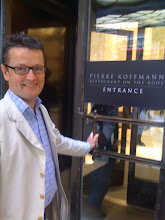
I was a guest of Bob Bob Ricard at this event and the shots of the restaurant entrance & members' bar are taken from their
 website.

Friday, 12 February 2010

Mussels with Mettle

I think mussels are underrated.  They are deliciously sweet, easy to prepare, nutritious, pretty, equally good raw or cooked, and plentiful in the UK and much of Europe.  They are also cheap (£3.50/kg); perhaps they do not receive the recognition they deserve because of this.
Posh fish like turbot and brill and shellfish like lobster have special, often expensive implements for cooking and eating them.  But when it comes to the "humble" mussel any old saucepan will do to boil them up; and then, one is expected to eat them using empty shells as utensils.
Using the shell as a kind of combined fork, knife and spoon is good though after a few mouthfuls the hinge breaks or one's fingers crush the shell in hasty enthusiasm.  Through my friend Amanda at the Goldsmiths' annual fair I met a silversmith who makes these exquisite and very realistic gold-plated mussel shells which possess an indefatigable hinge and a solid sterling silver body.
Eating mussels with one of these is a real joy and whilst one might feel a little foolish using one at home whilst sprawled on the sofa watching News at Ten on the box I reckon they have their place in smart fish restaurants like Scott's, Bentley's or Sheekey's.
Just make sure the plongeur doesn't end up chucking them in the bin.

Tuesday, 2 February 2010

Ham, Egg & Chips


A dish associated with greasy spoons and yet when prepared with care using good quality ingredients it is a culinary tour de force.  I do not understand why it isn't seen more often on restaurant menus.  

Here, the eggs were from my mother's Marans chickens, the potatoes were fried in duck fat, and the gammon ham came from Macken Brothers in Chiswick.  Normally, I would boil ham in water with maybe an onion or two, studded with cloves if I had any, and parsley stalks, a bit of celery, some carrot too.  But my sister Abi who is a Nigella fan (thought they were normally blokes) was dying to try out a recipe which involves Coca Cola.  Having not drunk coke since the age of 8 when it was a weekly treat at the vending machine of Loughton municipal baths I wasn't sure this was a good idea.  I know some fellow foodies drink it in the middle of the night when they've had too many sherberts and certain regiments use it to clean their rifles.  But poaching a ham in it?  Mmm.  

It was one of those be kind to sister days so she won and the ham did turn out very well.  The only downside to this recipe is that the poaching liquor cannot be turned into pea & ham soup, unless you're a coke head of course.

Sunday, 24 January 2010

Munster Cheese & Gewürztraminer Wine: a perfect match


Wine and food matching never excites as much debate as when the food in question is cheese.  It is true that a corner of mousetrap or a wedge of supermarket Brie will take the rough edges off a glass of plonky red but great cheese deserves decent wine and the most pleasurable combination will often be with a white (not to mention a beer, cider, sherry & port, or the occasional spirit).  

The problem in red wine is often the tannin which can clash with the fat in cheese, particularly the soft varieties.  And, the salt in cheese goes very well with the naturally higher acidity found in most whites.
The French especially have a tendency to serve their best red wines with the cheese and many a fragile mature red Burgundy or thin old Claret is laid waste by a board groaning and reeking with impossibly strong, runny, salty, acidic cheeses of which there are hundreds in France.  Far better really to serve just one cheese in perfect condition and match it with the appropriate wine.  And if in doubt about
which wine then sometimes local goes with local.  In this case,  Munster cheese from Alsace matched with white Alsatian Gewürztraminer.

Munster is a strong, 'wet rind', pooey cheese which demolishes most wines in its path.  Here however, the highish alcohol, luscious texture, residual sugar and very pronounced flavour of the wine (think lychees, rosewater, and a bag full of makeup) manages to match the cheese and create some harmony in spite of the seeming odds.

Occasionally Munster impregnated with cumin is sold.  This centuries-old practice came about as an aid to digestion (that well known digestif Kümmel is based on cumin) and again the aromatic spice matches the perfume of the wine (gewürz actually means spice in German) and the monster pong of the cheese.  Caraway seeds served separately are also traditional.  I discovered this at that Alsatian temple of gastronomy, l'Auberge de l'Ill, where the cheese course was made up of a plate of Munster in various guises including mini soufflé, mini croque monsieur, mini aumônière, fresh, solid and runny, and in the middle a bowl of caraway seeds, and on the side, a glass of fragrant, slightly sweet, vendanges tardives (late harvest),  Gewürz.  Perfect.


Thursday, 14 January 2010

Nice Apple Tart (Aumônière aux Pommes Flambée)


I'm a sucker for table-side preparation in a restaurant and the rare times I see "flambée" mentioned on a menu I invariably choose the associated dish.  In Paris, at the great brasseries like La Coupole and Terminus Nord, I always have crêpes Suzette  to give the waiter a chance to show off his pyrotechnic skills.  Similarly, I enjoy raw steak tartare as, even if they only very rarely chop the beef (or horse if you're lucky) in front of you these days, they still (in France at least) blend in the raw egg yolk, Dijon mustard, chopped shallots, capers and cornichons, condiments and seasonings with a flourish at the table and ask you how daring you want to be with the tabasco.

In this simple little restaurant in Nice I spotted aumônière aux pommes  on the menu followed by the magic word flambée so I had to have it.  Aumônière is an old word for purse (the type one would have tied to one's belt and where we get the words alms and almoner) and here represents the  pastry pouch holding the baked apple slices (and vanilla ice cream).  The waiter poured Calvados over the dish and then lit it with his little Bic lighter.  Notice in the short video below his forced laughter at my attempt at jocular engagement with him...
My French friend Claire points out that a true aumônière is made from pancakes and is therefore soft and bundles up like an oldfashioned purse. It's not clear to me however how one would tie it up at the top.  The chef here has used (Tunisian)  feuille de brik pastry which one can buy in packs of a dozen sheets from the supermarket rather like one can buy (Greek or Turkish) filo.  It's less brittle than filo though and can be merely moistened and shaped in a bowl before spending a few minutes in the oven.

Wednesday, 13 January 2010

Porchetta Pork Out


On a recent trip to Nice I was struck  by the Italian influence on local food. There are shops solely dedicated to selling handmade pasta. Or market stalls just selling tomatoes in various degrees of sun-induced dryness.  Pizza and its variants is everywhere and not just in restaurants; it is quintessential street food, as in Italy, and I saw people eating triangles of it whilst walking around, browsing in the markets, or sitting down at improvised little temporary, outdoor, snack bars.  The French are normally a bit more formal and parochial in their eating habits (I pretend the only people patronising all those McDonald's are foreign tourists) and I found this approach refreshing.

But having explored the town including its most magnificent square, named after Garibaldi who was a local, I recalled that Nice and its surrounding province was only incorporated into the French Republic in 1860 when Italy was unified.  Before that, Nice was part of the kingdom of Savoy which included Turin.  And much of the pizza I saw being eaten was actually pissaladière, a Provençal variant of the Neapolitan dish.
On further exploration I learned that gnocchi are actually Niçois and often accompany daube de boeuf, a Provençal take on boeuf bourguignonne.  Which is great because one has an excuse to sprinkle grated Parmesan all over one's plate.                                       
Much as the French love charcuterie they are rivalled, if not beaten, by the Italians with their vast range of salume.  In the narrow alleys of le vieux Nice I came across this glass cabinet containing two whole pigs bearing the label porchetta.  I couldn't believe my eyes.  The pigs had been completly boned out (save the head), then restuffed with meat, offal (including plenty of tripe) and herbs.  It was being sold as a kind of terrine.  But unlike many terrines, you could actually see the constituent parts.           Back at home for dinner, the herbs turned out to be (wild) fennel and the whole thing was highly seasoned, and dryish and crumbly rather than moist and fatty.  Delicious.  I often serve white wine with pork terrines, patés and rillettes (demi-sec Vouvray is good) but here a robust albeit rustic red was in order and we sunk a bottle of Côtes du Rhône.  A Barbera or Bardolino would have been more appropriate, I guess, but you can't expect the French to sell Italian wine, can you?  Even if they are Nice French.

Monday, 11 January 2010

Breakfast with a Bite

In our family we traditionally have smoked salmon & scrambled eggs for breakfast on Christmas Day (and I invariably serve this to French guests whenever they are staying as they find it novel and exotic... but less challenging than kippers or Full English).    Buck's Fizz is de rigueur to wash it all down.  On this particular occasion the supermarket-supplied ingredients all lacked impact. But, after a root around in the 'fridge for inspiration, a large splash of Campari came to the rescue for the Buck's Fizz and added bitterness and interest (and a lovely, innocent-looking grenadine hue) 
And to improve the slightly bland eggs and under-smoked salmon I found some little green peppers from Galicia in Spain, pimientos de Padrón.  Eating these is a bit like Russian roulette as the occasional one will be fatally fiery.  It's impossible to tell from their appearance which are which.  They need some hard frying in hot olive oil and then a sprinkling of sea salt.  They're often served as tapas and lend themselves to being eaten by hand by their little stalks.  They need something cold and wet to counteract any palate pyrotechnics and are usually accompanied in bars by a copita of chilled Manzanilla or Fino Sherry. But here, the grown up fizzy OJ was just the ticket...;     it was breakfast, after all.

Followers